If you’ve ever built a backyard mountain bike trail, you’ve probably run into this problem.
There’s something in the way.
In my case, it was a barbed wire fence cutting straight across the perfect line. I could have rerouted the trail.
Or…
I could build the DIY mountain bike feature you’ve all been asking for.
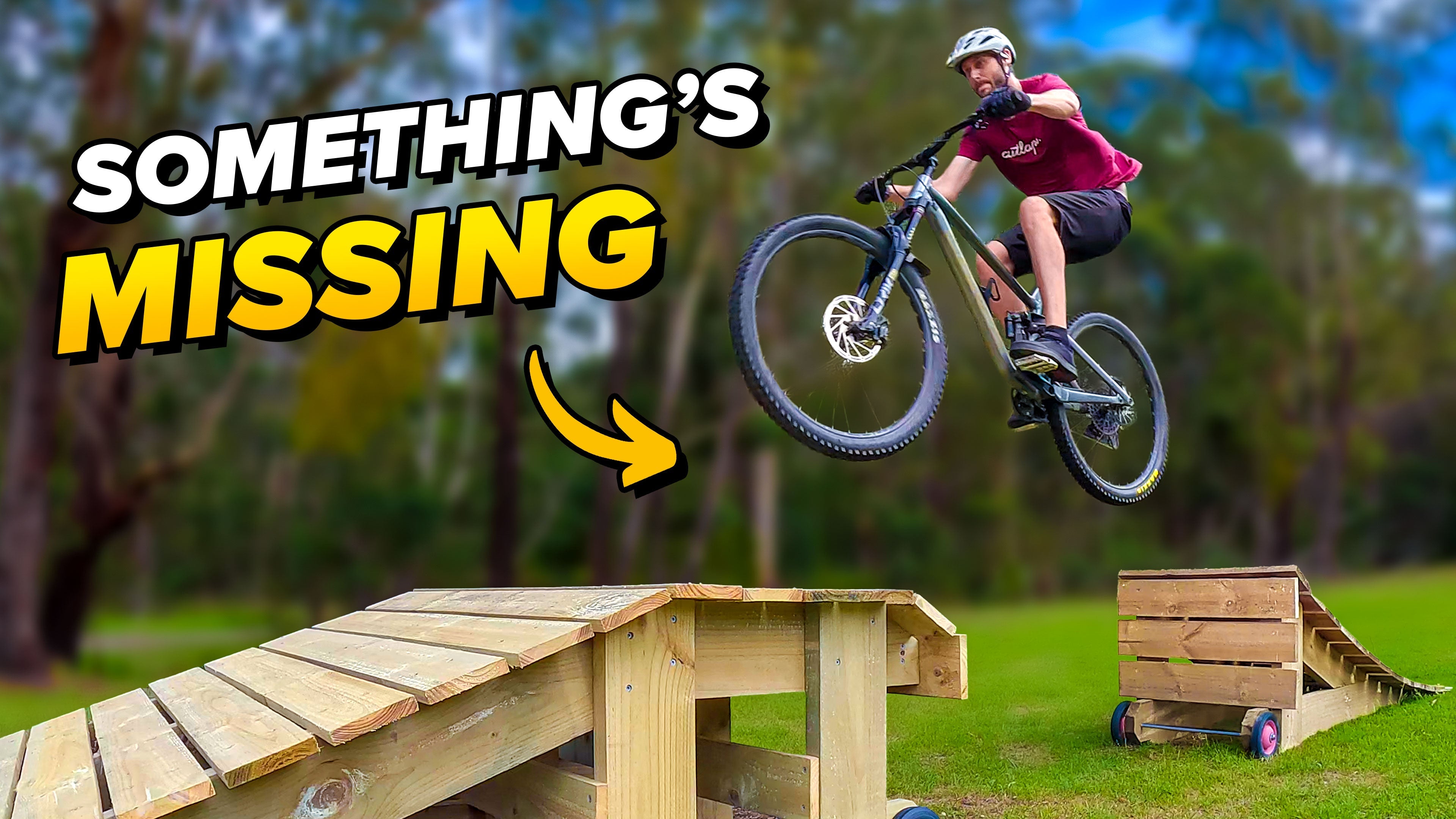
A mountain bike teeter totter (or as we call it in Australia, a seesaw).
And not a small one either. A full-size wooden mountain bike feature big enough to roll straight over the fence.
What could possibly go wrong?
Why Build a Mountain Bike Seesaw?
A mountain bike seesaw is one of the most iconic wooden MTB features you can add to a backyard trail.
- Teaches balance and timing
- Forces commitment
- Adds movement and unpredictability
- Looks absolutely insane
And most importantly, it makes your trail more fun.
Planning the Backyard MTB Seesaw
The concept was simple.
- Build a large wooden A-frame
- Run a 20-foot bridge across an axle
- Ride up one side
- Let it tilt
- Ride down the other
The reality was slightly more complicated.
Before building the bridge, I needed to construct a strong A-frame support that could handle all the weight and impact forces.
Building the A-Frame Support Structure
Every wooden mountain bike feature starts with solid foundations.
I sourced large logs from around the property and cut them to size. At first, I tried splitting a log lengthwise for extra usable timber, which worked, until I discovered I’d dropped it directly on top of an angry ants nest.
Lesson one of backyard trail building, always check what’s living under your timber.
Debarking the Logs
I removed the bark before building.
Why? Debarking slows the rotting process and helps the feature last longer. If you’re building a DIY mountain bike feature outdoors, moisture management matters.
Slotting the Logs Together
I cut grooves into the logs so they slotted together cleanly. This made the A-frame:
- Stronger
- More stable
- Better looking
Cross bracing was added to stiffen the entire structure. That’s what truly makes it an A-frame rather than just two leaning posts.
Designing the 20-Foot Wooden MTB Bridge
This was the most challenging part.
Building and installing a 20-foot seesaw bridge by yourself is no small task.
My first idea was to build a box frame and lift it into place.
That failed immediately.
Instead, I built two long stringers by laminating three pieces of timber together per side. This created strong, straight beams that were much easier to manoeuvre individually.
Why the Axle Hole Isn’t Centre
You might notice the axle hole isn’t drilled dead centre.
That’s intentional.
Most of the load pushes down on the top side of the axle. By leaving more material above the hole, the structure remains stronger under compression.
Small design choices like that make a big difference in long-term durability.
Installing the Axle and Balancing the Seesaw
Once both stringers were in place, I slid the threaded rod axle through and connected the bridge halves.
When I removed the temporary supports and let it tilt for the first time…
It went way further than expected.
That’s when I realised how steep this thing really was.
To make it reset automatically, I built the bridge slightly longer on the starting side. That way, gravity always pulls it back into position.
Simple. Effective.
Decking the Mountain Bike Seesaw
For the riding surface, I cut approximately 33 decking boards to size.
Here’s a quick tip if you’re building your own mountain bike seesaw: use a string line along the edge while installing decking. Line every board up against it and you’ll end up with a perfectly straight edge.
It’s a small detail, but visually it makes the feature look far more professional.
I also built a small wooden platform at the start so the seesaw had something solid to bounce back onto.
First Test Ride of the Giant MTB Teeter Totter
Standing at the base of it, it looked massive.
Three times bigger than any seesaw I’d ridden before.
The first attempt did not go to plan.
I didn’t commit enough speed and bailed awkwardly. The key with a mountain bike seesaw is getting beyond the tilt point cleanly. Too slow and you stall. Too fast and things get spicy.
After a few more attempts, I found the sweet spot.
Then I linked it into another wooden feature on the trail.
That’s when it really came alive.
Lessons from Building a DIY Mountain Bike Seesaw
If you’re thinking about building a backyard MTB teeter totter, here’s what I learned:
- Overbuild the support structure
- Offset your axle hole for strength
- Use cross bracing on the A-frame
- Make one side slightly longer for automatic reset
- Don’t underestimate how steep it will feel
A mountain bike seesaw is simple in theory, but it demands precision and confidence.
Is a Mountain Bike Seesaw Worth It?
Absolutely.
It solved my fence problem. It added a signature feature to my backyard mountain bike trail. And it set the stage for the roller coaster build that came next.
If you’re building your own DIY mountain bike features, this is a classic that never gets old.
Go dig.
Go ride.
See you in the next one.
Luke