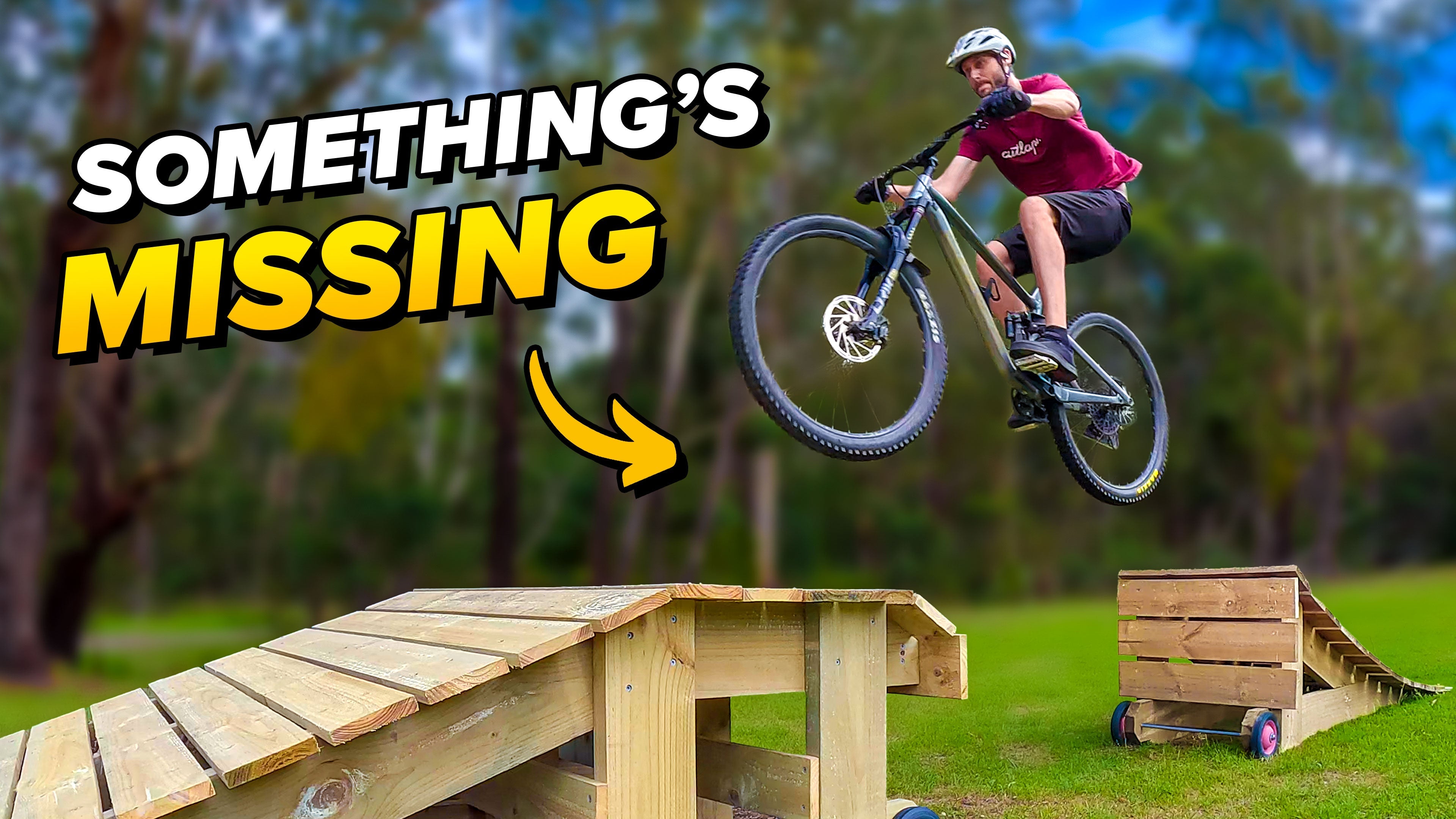
This is one of the biggest DIY mountain bike features I’ve ever built on my backyard mountain bike trail.
I decided to build a wooden mountain bike feature that’s basically a backyard MTB roller coaster. It starts on a mega seesaw over a barbed wire fence, drops into a flowing dip, charges through a dive turn, and finishes with a jump into the gully below.
A proper backyard roller coaster needs dips, turns and a bit of air time. But most importantly, it has to feel good to ride.
Here’s exactly how I built it.
How to Plan a Backyard Mountain Bike Roller Coaster
Before cutting any timber, I needed to work out where this wooden feature would sit on my backyard trail and how big it should be.
My planning method is simple:
- Tomato stakes
- String line
- Adjust. Adjust again. Adjust again.
By tying string between stakes, I can visualise the exact path of the feature. Small height tweaks make a massive difference to how smooth the final ride will feel.
The layout looked like this:
- A dip straight off the seesaw
- A “dive turn” to build speed
- A jump launching into the valley
Once I measured everything out, I realised something important. I needed a lot of wood.
So the next couple of days were spent chainsawing, debarking and hauling logs down the hill.
Building the Wooden MTB Bridge and Support Structure
Every wooden MTB bridge or elevated feature is only as strong as its foundations.
The first two vertical supports were critical because the seesaw needed to drop down and lock into them perfectly.
That meant digging holes. Lots of holes.
In total I buried 26 vertical supports. Digging is always harder than you think. There are rocks. There are roots. There’s always something slowing you down.
Once the posts were set, I used the string line again to guide the horizontal supports and start shaping the roller coaster properly.
Cutting Bird’s Mouth Joints
To get the stringers sitting flat on the horizontal supports, I cut bird’s mouth joints so there were no gaps between timbers.
That meant:
- Measuring both sides carefully
- Transferring angles
- Cutting clean notches
As the structure began to tilt and curve, the cuts became more complicated. Straight cuts no longer worked. I had to measure gaps and transfer angles manually to get everything sitting flush.
By the end of that day, my brain was fried. That’s when I made mistakes.
Twice I cut pieces too short because I was tired and rushing. That was the sign to stop. When building a DIY mountain bike feature, fatigue leads to wasted timber.
How to Build a Mountain Bike Jump in Your Backyard
The jump at the end of this backyard MTB roller coaster was all about flow.
I wasn’t trying to build something that sent you sky high. I wanted that smooth “whooof” feeling. You build speed through the berm and just shoot off the end naturally.
The tricky part was balancing:
- Jump length
- Takeoff angle
- Available landing space
If I built it too long, there wouldn’t be enough landing.
If I made it too short and steep, it would feel harsh and kill the flow.
I reshaped the dip at the start and curved the takeoff using a flexible pole to mark a clean transition. Small geometry changes made a big difference to how it would ride.
Landing Considerations
Because the feature starts from almost a standstill on the seesaw, I wasn’t sure how much speed I’d carry into the jump.
So I built a long, forgiving landing. If it needed reshaping, dirt is easy to adjust. Timber is not.
That’s something to remember if you’re planning to build a mountain bike jump in your backyard. Give yourself room to adapt.
How to Strengthen a DIY Mountain Bike Feature
Strength matters. Timber moves over time, especially on elevated wooden features.
To prevent flex and tilt, I added:
- Wedge bracing between stringers and supports
- Gusset plates over weak knots
- Extra reinforcement where needed
I used a small angle finder tool to mark wedge angles accurately. It’s a simple tool, but it makes strengthening your structure far easier.
Reinforcing weak points early means your DIY mountain bike feature will last years instead of months.
Decking and Final Adjustments
With the structure solid, it was time to lay the decking.
Halfway through, I noticed one section kicked up slightly too much. It probably would have ridden fine, but I lowered it by about 10 cm anyway.
That small tweak improved the geometry and made the roller coaster flow better.
It’s important to stay flexible when building features on a backyard trail. You rarely get it perfect the first time.
Backyard Mountain Bike Trail Building Tips
If you’re building your own DIY features, here are a few lessons from this project:
- Use string line to dial in curves before committing to cuts
- Expect digging to take longer than you think
- Stop when you’re tired, mistakes cost timber
- Reinforce weak knots and joints early
- Build dirt landings longer than you think you need
First Test Ride of the Backyard MTB Roller Coaster
There’s always that moment when you’ve spent days building something and now you actually have to ride it.
It looked big.
It looked scary.
I dropped in.
And it was way easier than I expected.
Smooth. Fast. Flowing.
That “whooof” feeling was exactly what I was chasing.
Mission accomplished.
If you’re interested in building your own backyard mountain bike trail, I’ve got more DIY mountain bike features, free plans and trail-building tools here on the site.
And if you want to see this wooden mountain bike roller coaster in action, check out the full build video over on YouTube.